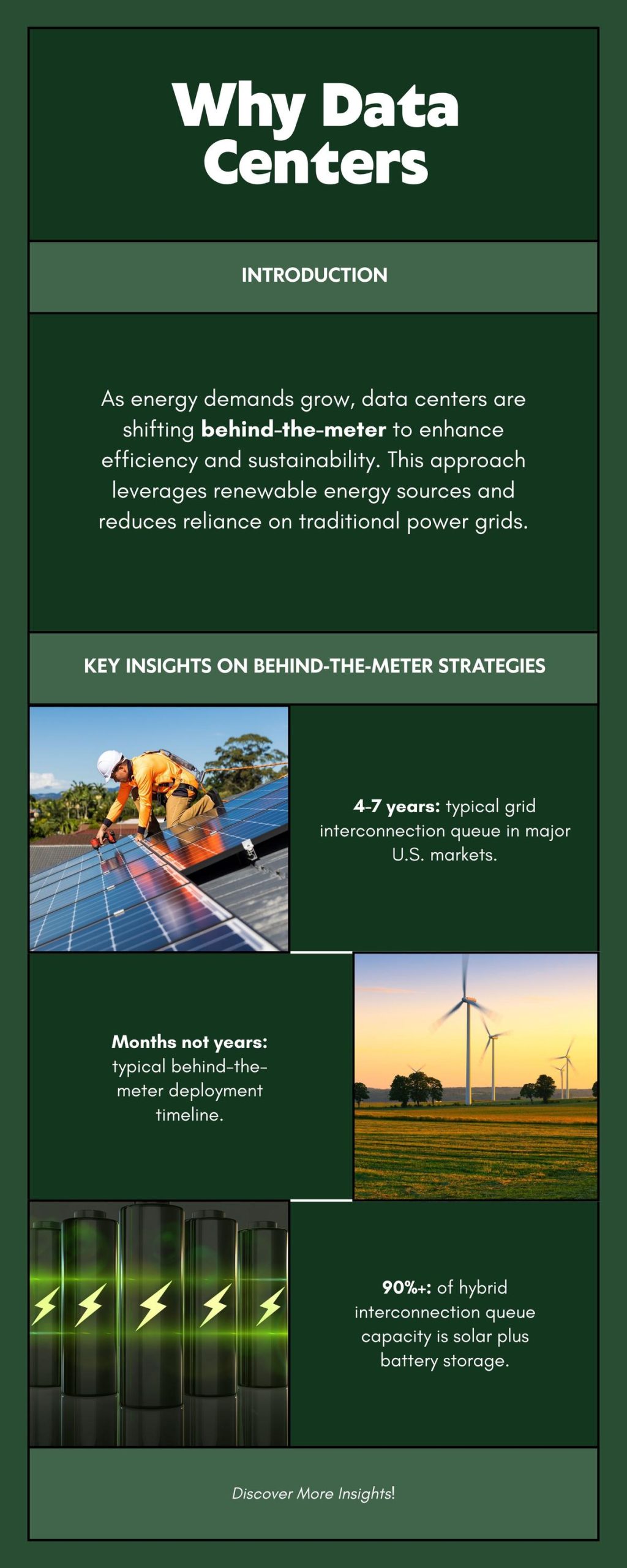
The largest constraint facing AI training, hyperscale cloud, and data center expansion in 2026 isn’t compute, isn’t real estate, and isn’t capital — it’s electricity. Specifically: how to get enough of it, reliably, at predictable cost, in a timeframe that matches business velocity.
This page lays out the comparison between two architectures for powering a modern data center: traditional utility grid interconnection versus on-site microgrid infrastructure. We’ll walk through interconnection timelines, cost economics, reliability, sustainability, and scalability — and where each approach makes sense.
If you’re a data center developer, operator, hyperscaler, or AI infrastructure decision-maker, this comparison is built for you.
Skip to a confidential consultation →
The Core Trade-Off
| Dimension | Utility Grid Power | On-Site Microgrid |
|---|---|---|
| Time to power | 5–7+ years (CA interconnection queue) | 18–36 months for utility-scale microgrid |
| Cost per MWh | Utility tariff + transmission + demand | LCOE of on-site solar/storage + (optional) gas firming |
| Reliability | Utility SLA + diesel backup | 99.99%+ with hybrid microgrid design |
| Scope 2 emissions | Grid mix (varies) | Verifiable, additive, near-zero with renewables |
| Scalability | Constrained by utility infrastructure | Modular, deploy as load grows |
| Capital structure | Utility opex (rate base) | Mix of capex, PPA, or EaaS |
| Demand charge exposure | Full retail tariff | Minimized through on-site generation |
| PSPS / outage exposure | Direct | Insulated via islanding |
| Federal ITC eligibility | Not eligible | 30%+ on solar/storage components |
| ESG mandate compliance (SB 253/261) | Difficult | Native |
Interconnection Timelines: Where the Math Breaks Down
According to the Lawrence Berkeley National Laboratory, the average time to complete the interconnection process in major U.S. ISOs has grown to over five years — and California’s CAISO and IOU queues are among the longest in the country for large industrial loads.
For an AI training operator who needs 50 MW of new power capacity to bring a GPU cluster online, “we’ll have it for you in 2031” isn’t an answer that survives a board meeting. The interconnection timeline alone often forces the conversation toward on-site generation — not because microgrid economics are better in a vacuum, but because utility-grid economics are functionally unavailable on the timeline the business requires.
A Raya-engineered microgrid can typically reach commercial operation in 18–36 months from contract execution, depending on permitting jurisdiction, equipment lead times, and site complexity. For many data center operators, the choice isn’t “utility power vs. microgrid.” It’s “microgrid in 2 years or wait 7 years.”
Cost Economics: It Depends on the Tariff
For a data center operator paying $0.12–0.18/kWh under a large-industrial tariff in California, on-site solar + battery storage typically delivers a blended cost of energy below the utility tariff after federal incentives — sometimes substantially below. Hybrid configurations that add natural gas firming for 24/7 dispatchability raise the blended cost but still typically outperform retail utility rates on a fully-loaded basis.
A few key cost dimensions:
- Demand charges under utility tariffs can exceed $25/kW/month on large industrial accounts in California. An AI training cluster with 30 MW of average load and 50 MW of peak load could face $1M+ per month in demand charges alone. Microgrid configurations with on-site storage routinely reduce demand charges by 60–80%.
- Federal Investment Tax Credit (30%+) applies to solar PV and battery storage components of a microgrid — but not to utility tariff payments. The ITC alone can shift the comparison by 30+ percentage points.
- Transmission and distribution charges embedded in utility tariffs disappear for on-site generation. In SCE, PG&E, and SDG&E territories, these can constitute 30–50% of the total per-kWh charge.
Raya develops project-specific cost modeling for every data center microgrid prospect, comparing on-site microgrid economics against the operator’s actual utility tariff — not against generic industry averages.
Reliability: How a Hybrid Microgrid Compares to Utility + Backup Diesel
Most existing data centers use a “utility + backup” reliability model: primary power from the public grid, with diesel generators sized to handle outages. Total uptime is constrained by the lower of two reliability numbers — utility availability and diesel start-and-run reliability.
A modern hybrid microgrid combining solar, battery storage, intelligent controls, and (optionally) natural gas generation can deliver 99.99%+ availability with substantially better failure mode characteristics:
- No single point of failure between multiple generation sources
- Automated islanding during grid disturbances — the microgrid disconnects from the utility and continues operating uninterrupted
- No diesel start latency — storage discharge begins instantaneously
- Lower failure rates than rotating diesel equipment
- Ongoing operation during PSPS events that take grid-dependent facilities offline
For AI training workloads where a single hour of unplanned downtime can cost hundreds of thousands of dollars in lost compute, the reliability case for a microgrid is often the single most compelling argument — independent of cost.
Sustainability: The Verifiable Difference
California SB 253 and SB 261 are now driving mandatory disclosure of corporate scope 1, 2, and 3 emissions. Federal procurement increasingly requires verifiable clean energy. Hyperscaler customers — Microsoft, Google, Meta, Amazon — are demanding scope 2 reductions from their colocation and infrastructure partners.
Grid power delivers an average of the local utility’s resource mix, which varies dramatically and which the data center operator cannot directly improve. On-site renewable generation through a microgrid delivers:
- Additive, verifiable clean energy — energy that wouldn’t have existed without the project
- Direct ownership of environmental attributes — Renewable Energy Certificates (RECs) accrue to the project owner
- Real-time emissions reporting for ESG disclosure
- Independence from utility resource planning cycles that don’t match corporate timelines
For an operator pursuing 24/7 carbon-free energy goals — increasingly common among hyperscalers — a properly engineered microgrid is the only architecture that delivers the outcome.
When Utility Power Is Still the Right Answer
Microgrids aren’t the right answer for every data center. Utility power makes sense when:
- The site is already interconnected with substantial capacity headroom for planned load growth
- The facility is in a market with low utility rates and no demand charge exposure (rare in California)
- The operator has no scope 2 emissions commitments and no near-term ESG mandate
- Site constraints prevent on-site generation at meaningful scale
For most California data center developments larger than 5 MW, none of these conditions hold. Which is why most California data center development is increasingly architected around microgrid infrastructure from day one.
How Raya Solar Approaches Data Center Microgrid Projects
Raya’s data center microgrid practice combines:
- In-house EPC across the solar, storage, electrical infrastructure, and controls layers — coordinated with the developer’s MEP and site civil teams
- Integration with the Microgrid Consortium ecosystem of controls and architecture partners for projects where Energy-as-a-Service or third-party financing structures are preferred
- Tax equity, direct-pay, and PPA structuring through partners with bankable balance sheets
- Hyperscale-grade engineering experience — including a multi-phase ~300 MW to 1 GW+ hyperscale microgrid program in Montana through parent company National Energy Installers
- Full code compliance — latest NEC, IEEE 1547, UL 1741, NFPA 855, NIST cybersecurity guidance, and California-specific requirements
Get a Confidential Consultation
If you’re evaluating data center power architecture for a hyperscale, colocation, or AI training facility, Raya Solar offers confidential technical consultation with our engineering team. We’ll model your specific load profile, site, and utility tariff against an on-site microgrid alternative — and tell you honestly which architecture serves you better.
Confidential consultation: hello@raya.solar
Direct line: 310-876-2832
Request a quote →
Raya Solar is a Los Angeles–based commercial and residential solar EPC and the data center microgrid infrastructure division of National Energy Installers, LLC. CSLB License #1038437. Member, Microgrid Consortium.